

The Scratching Doesn't Stop When You Finally Fall Asleep — Why Homeowners Are Reaching for This Before They Ever Touch Poison
The lie about a mouse problem is that once you deal with it, the noise stops.
It doesn't.
Sometimes it just gets replaced by something worse — a smell you can point to and can't reach.

Most people figure the worst part of having mice is the mice. It isn't. It's the four nights in a row you don't sleep, lying there working out exactly where in the wall the sound is coming from.
I figured the scratching would stop once I did something about it. Anything. I was wrong about that too.
What I Didn't Know About How Fast This Gets Worse
A mouse that's found shelter, food, and warmth inside your home has no reason to leave. So it doesn't. It settles in and starts a family.
According to the Merck Veterinary Manual, a single female mouse can produce up to 15 litters a year and can conceive again within 24 hours of giving birth.1 Her offspring reach breeding age in about six weeks.2
ESTIMATED MOUSE POPULATION GROWTH — UNCONTROLLED COLONY
Two or three mice that got in through a gap under the porch door in April can, in a matter of months, become a colony living in the walls, the garage, and the crawlspace — all without you seeing one of them cross the floor.
My Name Is David Whitfield
I'm 68. Retired machinist, outside Dayton, Ohio. Married thirty-nine years. Our granddaughters stay with us most weekends in the summer, and our dog, Cooper, sleeps at the foot of our bed.
Last summer I found out what a mouse problem actually costs a family — not just in dollars, but in sleep, and in how safe your own kitchen feels at two in the morning.

It Started With a Sound I Didn't Recognize
First week of June. I'd had the windows cracked for weeks. That night I heard scratching behind the stove — not the odd tick I'd been hearing all spring. This was constant. High up in the wall.
I told myself I'd deal with it in the morning. I didn't sleep. Neither did Linda. Four nights in, I was lying there at two in the morning listening for the next sound, jumping every time the house settled — thinking it was something in the wall instead.
"That's not one mouse," Linda said.
She was right.
What I'd Already Tried
By then we'd been through most of the list. Snap traps caught two the first week, then nothing — the rest learned to avoid them. Glue traps we won't use again.
The poison worked, in the sense that the scratching in one section of wall finally stopped. Four days later I understood why. There's a smell that comes from a wall void that no candle touches and no window fixes. You can stand in your own kitchen and point at exactly which stud bay it's coming from, and there's nothing to do about it except wait it out — or open the wall to get to it.
I called an exterminator over it, more out of desperation than anything else.
The Call to the Exterminator
$150 just to walk the property and confirm what I already knew. He didn't sound surprised.
"That's a common callback, Mr. Whitfield. Bait kills them where they die, not where you'd like them to. Wall voids, subfloors, behind cabinetry — you're looking at anywhere from a week to a month before it clears on its own, or we open the wall."
I asked what the full treatment would run. Nearly $4,000, spread across several visits — bait stations, exclusion work, and no promise it wouldn't happen again next time something got in.
I didn't want to gamble another mouse into a wall I couldn't get to.
Why the Plug-In Devices Keep Failing People
A neighbor of mine, Tom, had gone through his own version of this two summers back — and landed on something that actually held.
"The reason those single-tone devices stop working isn't the mice getting braver," he told me over the fence. "It's habituation. Same signal, same pattern, every night — their brain just tunes it out, same as anything else it learns is harmless."
What I found afterward is that rodents don't habituate to a threat that keeps changing. A predator that always sounds and moves the same way stops being a threat. One that keeps shifting never does.
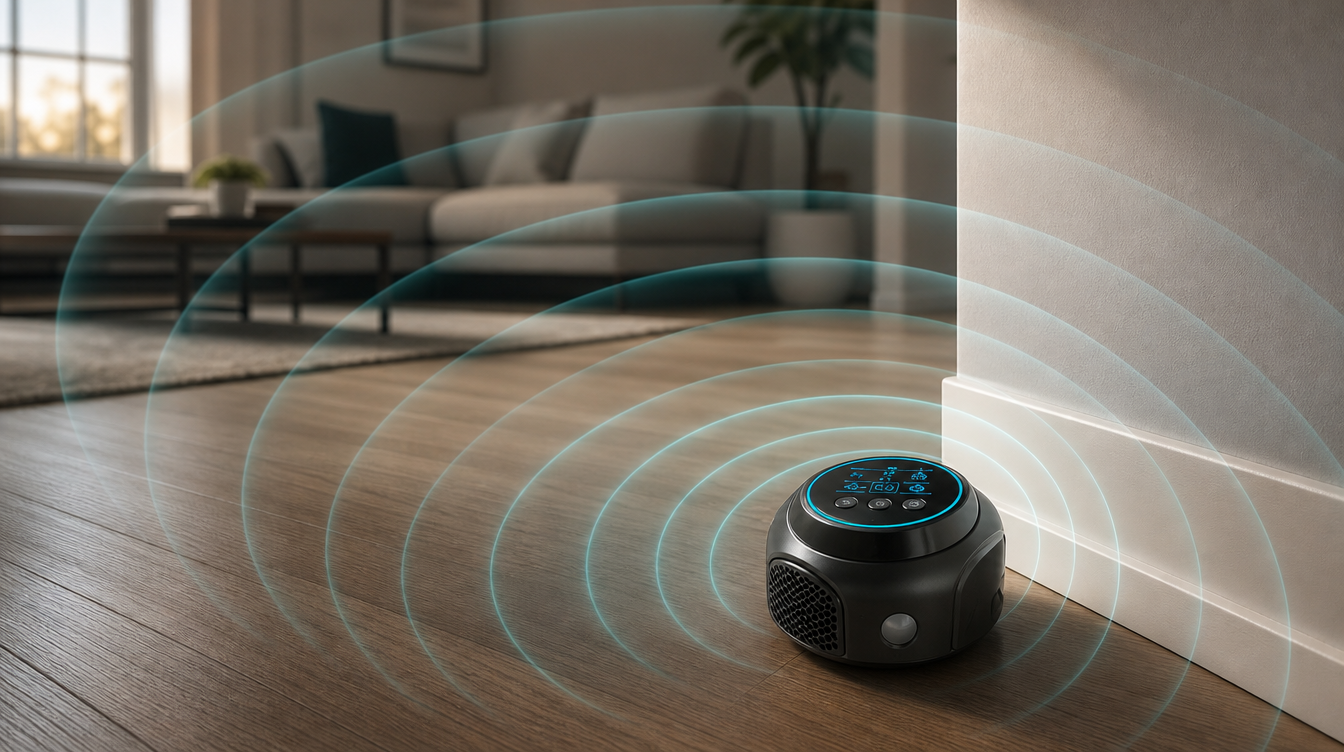
That's the idea behind the device Tom pointed me to — DremaTech's 4-in-1 Rodent Shield. Instead of one constant tone, it rotates through four modes — ultrasonic, electromagnetic pulse, pressure wave, and strobe — Multi-Signal Defense, so there's never a stable pattern for a mouse to get comfortable with. And nothing dies in a wall you can't get to.
How It's Meant to Work
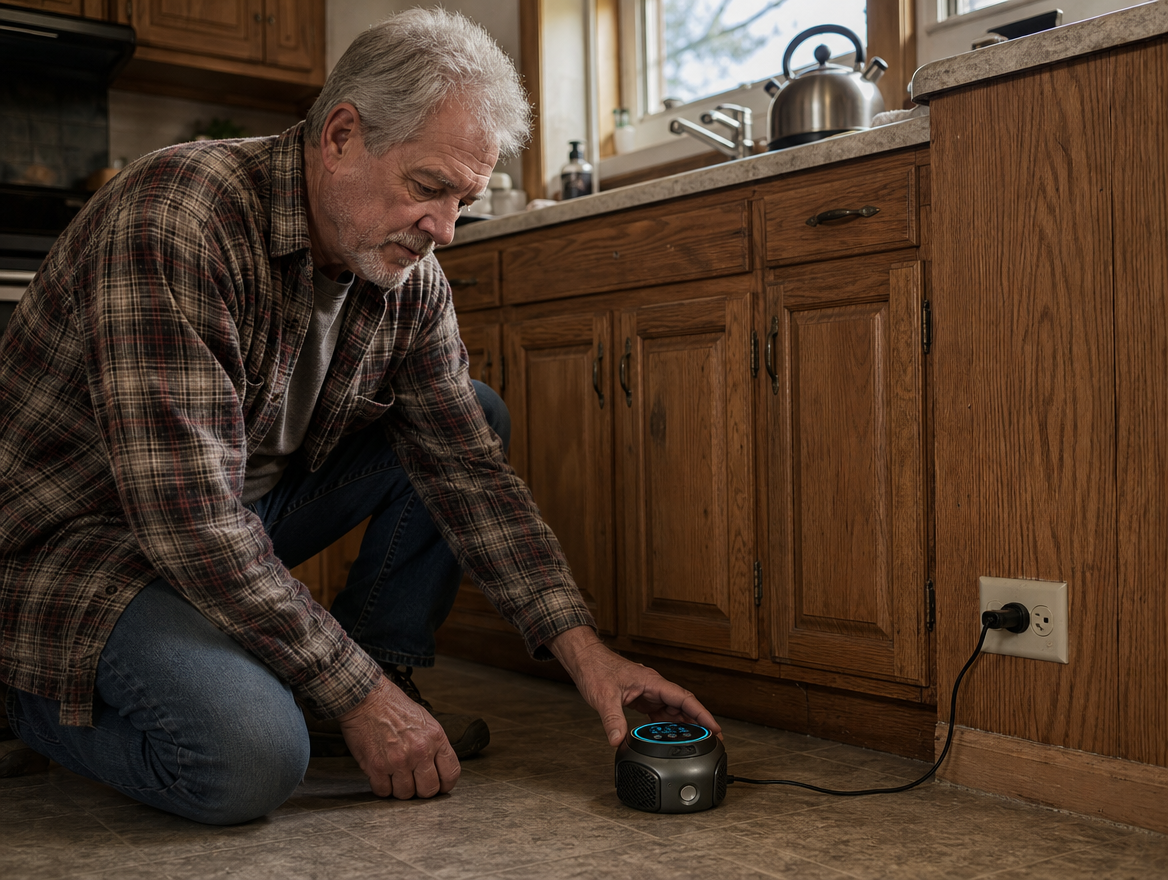
Plug it into an outlet along the wall where you've seen activity. It cycles automatically between the four modes so the environment stays unpredictable to a rodent's senses. No bait, no poison, nothing dying somewhere you'll smell it three days later and can't reach.
It won't work everywhere overnight, and DremaTech doesn't claim it will. What it's built to do is remove the "safe, familiar" environment that lets mice settle in — without trading a scratching problem for a decomposition problem.

What We Actually Noticed
We placed ours behind the stove, one in the garage, one near the crawlspace access.
First week, I wasn't convinced. I still heard something one night and nearly called Tom in a bit of a panic. He told me to give it two weeks — that the first week is just the existing mice figuring out the house isn't safe for them anymore.
Second week, it stopped. Not "quieter." Stopped. I lay there one night waiting for a sound that didn't come, and realized that was the first time in over a month I wasn't bracing for it.
Linda noticed before I said anything. "When's the last time you heard them?" she asked one morning. I had to think about it. That was the point — I'd stopped thinking about it.
What Other Homeowners Have Reported

Hadn't slept through the night in almost two weeks. Every time I dozed off I'd hear it again, right above the bedroom. My wife thought I was losing it honestly. Plugged this in on the Tuesday, put it up near the loft hatch like the guide said. Thursday night was the first full night I'd had in weeks. Woke up actually rested for once.

I've kept this garage in order for thirty years, never had a problem I couldn't handle myself until this. Found droppings behind the workbench and it threw me, honestly. Got a quote from an exterminator and about fell over at the price. Ordered this instead, followed the placement guide, sealed a gap by the side door myself. Feels like my space is mine again haha.

What got me wasn't even seeing one, it was finding droppings on the shelf right next to where the grandkids' snacks were kept. Made my skin crawl thinking about what they'd been exposed to… Won't do poison with the dog and grandkids in and out of the barn all summer, so this was really the only thing that made sense. Three weeks now, nothing on that shelf since.
The Choice, As I See It
Do nothing: the colony that's already inside keeps growing. The scratching gets worse, not better, and so does the sleep loss.
Use poison: it can work — until it works in the wrong place. A dead rodent in a void you can't access means a smell you'll live with for days or weeks, or a wall you end up opening to fix it.
Try something that pressures them out instead of killing them where you can't reach: that's the bet we made, and for us, it paid off.
Summer Home Offer — 48 Hours
Right now, DremaTech is running a summer offer specifically for home infestations:

- 50% off the 4-in-1 Rodent Shield
- 60-Day Money-Back Guarantee
- Free Home Protection eBook with every order
- Offer window: 48 hours from when you're reading this

60-Day Money-Back Guarantee
If you're not satisfied with how the Rodent Shield is working for your home within 60 days, contact DremaTech customer service for a refund.
A: It varies by home and how established the activity is. Many customers report noticing less activity within the first few weeks of consistent use. This isn't an instant fix, and results aren't guaranteed on a fixed timeline.
A: The Rodent Shield uses no bait or poison. It's designed to be safe around cats and dogs when used as directed, with nothing on the floor for a pet to get into.
A: Most ultrasonic plug-ins emit one constant tone. Rodents adapt to a fixed signal within weeks — it becomes background noise. The Rodent Shield rotates between four different signal modes so there's no single pattern to adapt to.
A: You're covered by DremaTech's 60-Day Money-Back Guarantee. Contact customer service within that window for a refund.
A: For a typical home, one unit per problem area (kitchen, garage, crawlspace access) is the standard starting point. Larger or more established infestations may need more than one.
A: The Rodent Shield won't remove an existing odor issue — that has to run its course or be addressed physically. What it's built to prevent is that happening again, by making the space undesirable to new activity before it nests deep in a void you can't reach.
A: No. The 50% summer discount is a limited seasonal offer tied to home-infestation season and runs for 48 hours from when you view this page.
P.S. — Summer is when a colony that's already inside your walls does the most breeding. The four nights I didn't sleep, followed by the four days I couldn't stand my own kitchen — that was the cost of waiting and then guessing wrong about what to do next.
THIS IS AN ADVERTISEMENT AND NOT AN ACTUAL NEWS ARTICLE, BLOG, OR CONSUMER PROTECTION UPDATE.
MARKETING DISCLOSURE: This website is owned and operated by The Anderson Shop Ltd, operating as DremaTech.
Individual results may vary. The 4-in-1 Rodent Shield is a deterrent device; it does not kill, exterminate, or eradicate rodents. Safe around cats and dogs when used as directed. Testimonials reflect real customer experiences; results are not guaranteed. This advertorial is paid promotional content.
Privacy Policy | Terms of Service | Contact
© 2026 The Anderson Shop Ltd / DremaTech. All Rights Reserved.
Sources: 1. Merck Veterinary Manual, "Breeding and Reproduction of Mice." 2. Batzner Pest Management, "The Rapid Reproduction Rate of Mice." 3. Federal Trade Commission, 2001 advisory to manufacturers of ultrasonic pest-control devices.